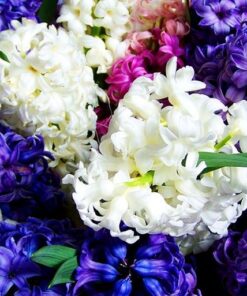
Hyacinths are among the most beloved and recognizable spring bulbs, renowned for their intensely fragrant flower spikes and vibrant colours. Native to the eastern Mediterranean region, these perennial plants belong to the family Asparagaceae and have been cultivated for thousands of years, with references dating back to ancient Greek and Roman civilizations. The most commonly grown species is Hyacinthus orientalis, which produces dense, cylindrical clusters of small, bell-shaped flowers atop sturdy stems that typically reach 8-12 inches in height. The flowers come in a spectacular range of colours including deep purple, pink, white, yellow, salmon, and various shades of blue. Each bulb produces a single flower spike, though mature bulbs may develop multiple stems over time. Hyacinths are prized for their powerful, sweet fragrance that can perfume entire gardens when planted in groups. This aromatic quality made them particularly popular during the Victorian era, when they were often grown indoors as cut flowers or forced bulbs for winter blooms. These hardy bulbs are relatively easy to cultivate, preferring well-draining soil and full to partial sun exposure. They’re ideal for naturalizing in woodland gardens, formal spring displays, or container plantings. Hyacinths require a cold winter period to bloom properly. In Greek mythology, hyacinths are associated with the tragic tale of Hyacinthus, a beautiful youth accidentally killed by the god Apollo. From his blood sprang the first hyacinth flowers, giving the plant symbolic meanings of rebirth, constancy, and sometimes sorrow. Modern gardeners appreciate hyacinths not only for their beauty and fragrance but also for their reliability as early spring bloomers, often appearing alongside daffodils and crocuses. After flowering, the foliage should be left to die back naturally, allowing the bulb to store energy for the following year’s display.


Flower Bulbs


Flower Bulbs